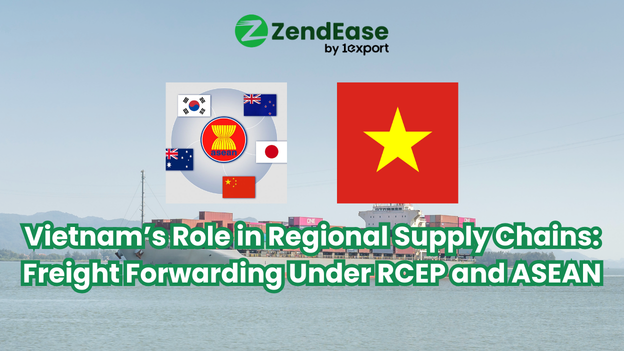
Vietnam’s Role in Regional Supply Chains: Freight Forwarding Under RCEP and ASEAN
by Ly Nguyen on Mar 11, 2026
Over the past decade, Vietnam has become one of Southeast Asia’s fastest-growing trade hubs. From electronics and garments to agricultural exports and coffee, goods produced in Vietnam are now moving across Asia and beyond at an increasing pace. But behind this growth lies a bigger trend — regional supply chains.
Today, many products are no longer manufactured in just one country. Instead, materials, components, and finished goods move across several countries before reaching their final destination. Regional trade agreements such as RCEP and ASEAN economic cooperation are helping make this process easier. These frameworks reduce trade barriers, simplify customs procedures, and encourage companies to build supply chains across multiple countries in Asia.
As a result, Vietnam is becoming an increasingly important link in regional trade networks — and freight forwarding services are playing a key role in keeping goods moving smoothly.
Why Vietnam Is Becoming a Regional Supply Chain Hub
Vietnam’s growing role in regional supply chains is driven by several important factors.
Strategic geographic location
Vietnam sits along some of the busiest trade routes in Asia. It shares a border with China and has access to major shipping lanes connecting Southeast Asia with global markets. This location makes Vietnam an ideal base for companies that need to move goods between multiple countries quickly and efficiently.
Strong manufacturing growth
Vietnam has developed strong manufacturing sectors in industries such as:
- Electronics and consumer devices
- Textiles and garments
- Footwear
- Agricultural exports
Many international companies now manufacture products in Vietnam before exporting them to markets across Southeast Asia and beyond.
Expanding trade agreements
Vietnam is also part of several major trade agreements that support cross-border trade. Two of the most important frameworks are:
- The Regional Comprehensive Economic Partnership (RCEP)
- The ASEAN Free Trade Area
These agreements help reduce tariffs and simplify trade procedures between member countries.
What Is RCEP and Why Does It Matter?
The Regional Comprehensive Economic Partnership (RCEP) is currently the largest free trade agreement in the world. It includes 15 economies across Asia-Pacific, including:
- Vietnam
- China
- Japan
- South Korea
- Australia
- New Zealand
- All ASEAN member countries
Together, these markets account for roughly 30% of global trade and GDP. For businesses involved in international trade, RCEP creates several important advantages.
Lower tariffs across the region
One of the biggest benefits of RCEP is the gradual reduction of tariffs on traded goods. For exporters, this can mean:
- Lower import duties
- More competitive pricing in foreign markets
- Greater access to customers across Asia
For example, Vietnamese businesses exporting goods to other ASEAN countries may benefit from reduced tariffs compared to previous trade conditions.
Flexible rules of origin
Another key feature of RCEP is the regional rules of origin system.
In simple terms, this means materials from different member countries can still qualify for trade benefits when used together in manufacturing. For instance:
- Raw materials may come from China
- Components may be manufactured in Vietnam
- Final products may be exported to the Philippines
Even though multiple countries are involved, the shipment may still qualify for preferential tariffs under RCEP. This flexibility encourages companies to build supply chains that span several countries in the region.
Faster customs procedures
RCEP also focuses on improving customs efficiency. Many shipments between member countries now benefit from:
- Simplified documentation requirements
- Faster customs processing
- Reduced administrative barriers
For businesses shipping goods internationally, this helps reduce delays and improve supply chain reliability.
The Growing Importance of Freight Forwarding
While trade agreements make international commerce easier, they also create more complex logistics networks. When products move between multiple countries, businesses must coordinate:
- Shipping schedules
- Customs paperwork
- Cargo consolidation
- Import and export compliance
This is where freight forwarders become essential. A freight forwarder manages the logistics process on behalf of businesses, ensuring shipments move smoothly from origin to destination. Typical freight forwarding services include:
- Booking cargo space via air or sea
- Managing export and customs documentation
- Consolidating shipments to reduce shipping costs
- Coordinating cross-border transportation and delivery
Without proper logistics coordination, companies may face delays, unexpected costs, or compliance issues.
New Opportunities for SMEs
Regional trade agreements like RCEP are not only beneficial for large corporations. They also create new opportunities for small and medium-sized businesses (SMEs). With improved market access and reduced trade barriers, smaller businesses can now participate more easily in international trade.
For example, a Vietnamese SME can:
- Source materials from another RCEP country
- Manufacture products locally in Vietnam
- Export finished goods to markets such as the Philippines, Thailand, or Singapore
However, international shipping can still be challenging for smaller companies — especially when dealing with customs regulations and logistics planning. Working with experienced freight forwarding partners can help SMEs manage these challenges more efficiently.
Vietnam’s Future in Regional Supply Chains
Vietnam is expected to play an even larger role in Asia’s regional supply chains in the coming years. Several trends are driving this growth:
- Increasing foreign investment in Vietnamese manufacturing
- Expansion of logistics infrastructure and ports
- Growing demand for diversified supply chains in Asia
As more companies build multi-country production networks, Vietnam is well-positioned to serve as a key link between manufacturing and regional markets. However, efficient logistics coordination will remain critical for businesses operating across borders. Freight forwarding services will continue to play an important role in ensuring goods move smoothly across Southeast Asia.
Simplify Cross-Border Shipping with ZendEase
Shipping products across Southeast Asia can be complex — but it doesn’t have to be. ZendEase helps businesses manage cross-border logistics from Vietnam to markets across the region, including the Philippines.
Our services include:
- Freight forwarding via air and sea
- Shipment consolidation
- Export documentation support
- Cross-border delivery coordination
Need help with your shipment?
Contact the ZendEase team today and let us help you move your goods across Southeast Asia smoothly and efficiently. Reach out to us at vn@zendease.com.