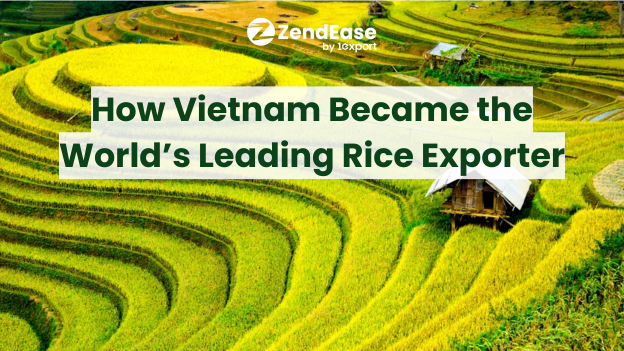
How Vietnam Became the World’s Leading Rice Exporter
by Ly Nguyen on Sep 30, 2026
Through decisive market reforms (Đổi Mới), high-yield agricultural innovation, and continuous supply chain modernization in the Mekong and Red River deltas, Vietnam transformed from a food-insecure nation into a top global rice powerhouse. For international buyers and food importers today, Vietnamese rice offers an ideal combination of consistent year-round supply, award-winning premium varieties like ST25, and direct freight access from major shipping hubs like Ho Chi Minh City.
To understand Vietnam’s position in the global grain market today, it helps to look back just a few decades. In the late 1970s and early 1980s, the nation was struggling with severe food shortages and relied heavily on international humanitarian food aid. Farmland was managed under rigid state collectives, production incentives were low, and national yields barely met domestic consumption needs.
Fast forward to today, and Vietnam consistently ranks alongside India and Thailand as one of the world's top rice exporters. Generating billions in export revenue and shipping over 7 to 8 million metric tons annually to major international markets across Asia, Europe, the Middle East, and the Americas, Vietnam’s agricultural turnaround is widely considered one of the most successful economic stories in modern history.
How did this remarkable transformation happen? Here is the story of Vietnam’s agricultural rise and what it means for global buyers today.
1. The Policy Spark: Resolution 10 and Đổi Mới Reforms
The pivotal turning point arrived in the late 1980s. Under the landmark Đổi Mới (Economic Renovation) policies initiated in 1986 and strengthened by "Resolution 10" in 1988, the Vietnamese government dismantled the collective farming system.
Instead of working solely under state-managed cooperatives, farmland was leased directly back to individual farming households. Farmers were granted long-term land-use rights, allowing them to make independent operational decisions, sell surplus crops on the open market, and keep their hard-earned profits.
The shift in productivity was immediate. By 1989—just three years after Đổi Mới began—Vietnam had stopped importing rice altogether and shipped its very first export surplus of 1.4 million metric tons.
2. Unmatched Scale in the Mekong and Red River Deltas
While policy provided the initiative, geography provided the natural engine. Vietnam benefits from two of the most fertile agricultural basins in Asia:
- The Mekong Delta: Known as the "Rice Bowl of Vietnam," this vast southern plain accounts for over 50% of the nation's total rice production and more than 90% of its export volume. Tropical climate conditions and dense river networks allow farmers to harvest two to three crops every year.
- The Red River Delta: The agricultural engine of northern Vietnam, providing steady high crop yields and food security for major regional urban centers.
Massive state and private investments in irrigation canals, dike systems, and flood control turned these deltas into reliable, year-round production powerhouses capable of withstanding seasonal weather variations.
3. From Quantity to Quality: The High-Yield & Specialty Revolution
In the 1990s and 2000s, Vietnam focused primarily on volume, shipping high quantities of standard 5% to 25% broken white rice. However, over the past decade, the agricultural sector underwent a deliberate quality revolution.
Vietnamese agronomists successfully bred high-performing hybrid seeds resistant to local pests, drought, and saltwater intrusion. More importantly, Vietnam pivoted toward premium, fragrant varieties that command higher prices in international markets:
- ST24 and ST25 (World's Best Rice): Bred in Soc Trang Province, ST25 won the prestigious "World's Best Rice" award multiple times, putting Vietnamese fragrant rice on the global culinary map.
- Jasmine & DT8: Premium, long-grain fragrant varieties that have captured significant market share across the Philippines, the Middle East, and North America.
- Japonica & Glutinous Rice: Specialized round-grain and sticky rice varieties tailored for Japanese, Korean, and specialty food processing markets worldwide.
Rice Variety & Export Market Breakdown
| Rice Variety | Key Characteristics | Primary Export Markets |
|---|---|---|
| ST25 / ST24 | Premium fragrant rice, pandan aroma, soft & chewy texture | USA, Europe, Japan, High-end Asian retail |
| DT8 / Jasmine | High-aroma long-grain, soft texture, excellent price-to-quality ratio | Philippines, Middle East, Africa |
| 5% - 15% Broken White | Economic everyday staple, high volume availability | Indonesia, Philippines, African nations |
| Glutinous / Sticky Rice | High starch, specialized for traditional foods & industrial processing | China, Regional Southeast Asia |
Why This Matters for International Buyers & Exporters Today
Vietnam's agricultural evolution directly benefits cross-border importers, wholesalers, and food distributors:
- Reliable Year-Round Supply: Triple-cropping cycles in the Mekong Delta ensure that fresh harvests are available almost every quarter, protecting international buyers from seasonal supply shortages.
- Diverse Product Options: Importers can source everything from budget-friendly bulk white rice to organic specialty grains and award-winning ST25 within a single market.
- Competitive Freight Logistics: Situated along major maritime routes with deep-water port access around Ho Chi Minh City and Ba Ria-Vung Tau, Vietnam offers fast, cost-effective shipping to Southeast Asia, Europe, and the Americas.
Source & Ship Agricultural Goods with ZendEase
Whether you are an international importer sourcing full container loads of Vietnamese rice or a business shipping specialty food products and regional agricultural goods abroad, ZendEase Vietnam provides end-to-end logistics support:
- Cargo Inspection & Repacking: Ensure your agricultural shipments meet strict export standards with warehouse inspection, moisture-proof repacking, and label compliance at our Ho Chi Minh City hub.
- Express & Freight Solutions: Fast door-to-door air express and ocean freight coordination connecting Vietnam with the Philippines, Southeast Asia, and global markets.
- Pasabuy & Sourcing Support: Hassle-free logistics assistance for sourcing agricultural specialty products directly from verified Vietnamese suppliers.
Ready to source or ship agricultural products from Vietnam? Contact the ZendEase Vietnam team today for a transparent, fast freight quote!