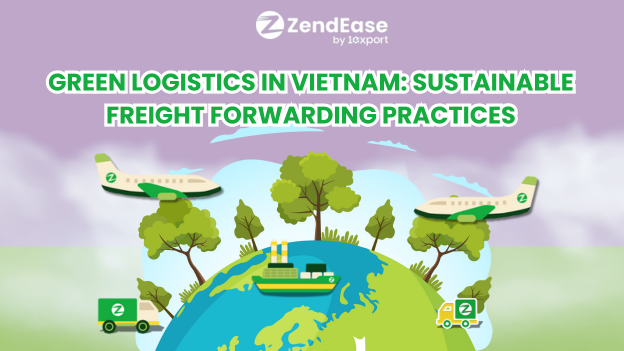
Green Logistics in Vietnam: Sustainable Freight Forwarding Practices
by Ly Nguyen on Feb 10, 2026
In the current global trade landscape, sustainability has transitioned from a niche corporate social responsibility (CSR) initiative to a fundamental pillar of supply chain strategy. As Vietnam solidifies its position as a premier manufacturing and export powerhouse in Southeast Asia, environmental performance is becoming a critical metric in how goods are transported, managed, and documented.
At the heart of this transformation are freight forwarders. Positioning themselves at the nexus of exporters, carriers, and regulatory authorities, forwarders are now the primary architects of carbon reduction and resource efficiency. Their role is essential in helping shippers meet the rigorous Environmental, Social, and Governance (ESG) expectations of international buyers.
The Drivers of Change: Why Sustainability Matters in Vietnam
The rapid industrialization of Vietnam—centered around key hubs like Ho Chi Minh City, Hai Phong, and Cai Mep–Thi Vai—has led to a significant surge in cargo throughput. However, this growth has brought challenges, including urban congestion and rising carbon emissions.
Today, the push for "Green Logistics" is largely driven by market demand. Multinational buyers now integrate environmental performance into their supplier scorecards. Vietnamese exporters are increasingly required to disclose data on transport modes, consolidation efficiency, and digital adoption. Consequently, forwarders are re-engineering traditional shipping models to remain competitive on the global stage.
Practical Frameworks for Sustainable Forwarding
Sustainable logistics in Vietnam is not defined by a single action, but by a series of operational refinements across the shipment lifecycle:
1. Strategic Mode Selection and Carbon-Aware Planning
The most effective tool for emission reduction is transport mode optimization. Forwarders are increasingly advocating for ocean freight over air freight whenever production timelines allow, due to its significantly lower carbon footprint per unit. By engaging clients early in the production cycle, forwarders can build necessary "buffer times" into schedules, allowing for greener routing without compromising delivery deadlines.
2. High-Efficiency Consolidation and Network Design
Consolidation is a cornerstone of lowering emissions. By grouping cargo from various suppliers into shared containers or pallets, forwarders maximize load factors and eliminate under-utilized transport movements. This is particularly effective in high-frequency corridors serving ASEAN and trans-Pacific routes. Furthermore, strategically placing consolidation hubs near industrial clusters minimizes inland haulage distances, reducing fuel consumption at the source.
3. Collaborative Partnerships and Route Optimization
Sustainability requires a unified front between forwarders and carriers. Forwarders are prioritizing partnerships with shipping lines and airlines that invest in modern, fuel-efficient fleets and transparent ESG reporting. On the ground, route optimization—including port gate appointment coordination and avoiding peak-hour traffic—helps minimize idle time and fuel waste.
4. Modernizing Warehouse and Cross-Dock Operations
Logistics parks are evolving into energy-efficient ecosystems. The adoption of LED lighting, optimized racking, and electric material-handling equipment is becoming standard. In many Vietnamese facilities, the integration of rooftop solar panels and digital Warehouse Management Systems (WMS) is further reducing reliance on traditional energy and paper-based processes.
5. The Transition to Paperless Trade
Digitalization is perhaps the most visible shift in the industry. The transition from physical paperwork to electronic customs platforms and digital bills of lading does more than just save paper; it eliminates the need for courier trips between offices and ports, significantly reducing ancillary emissions. For the shipper, this translates to faster clearance times and enhanced transparency.
Addressing the Challenges of Transition
The path to green logistics in Vietnam is not without its hurdles. Infrastructure limitations, particularly road congestion in dense urban zones, remain a primary obstacle. While rail freight for containers is growing, it is still in the developmental stages, and access to low-emission trucking varies by region.
Furthermore, smaller exporters may find the initial costs of sustainable packaging or the extended lead times of sea freight challenging to balance against commercial realities. In this context, forwarders act as vital consultants, guiding clients toward a sustainable equilibrium.
How ZendEase Vietnam Integrates Sustainability into Daily Operations
Within this shifting landscape, ZendEase by 1Export views sustainability as an integral component of routine operational planning. Rather than treating "green" as a standalone program, ZendEase emphasizes practical, high-impact measures:
- Active Shipment Consolidation to maximize load efficiency.
- Strategic Consultations on transport modes and inland route optimization.
- Digital Documentation to streamline trade and reduce paper waste.
By embedding these practices into daily execution, ZendEase supports clients in achieving responsible supply chain goals while maintaining the service reliability they depend on.
The Path Forward for Importers and Exporters
For businesses shipping from Vietnam, the future of logistics depends on proactive engagement. Sustainability is most effective when discussed early in the planning process. Shippers should evaluate consolidation opportunities, inquire about domestic trucking efficiency, and prioritize logistics partners that utilize digital systems.
As Vietnam continues to lead in global manufacturing, environmental performance will only grow in importance. Forwarders who lead the way in network design and digitalization will be the ones to define the next era of Vietnamese trade.
Build a Resilient, Responsible Supply Chain
Is your logistics strategy aligned with global sustainability trends? Contact vn@zendease.com today to discuss how we can optimize your Vietnam-based shipments for efficiency and environmental performance.